État des Lieux in France: what the law actually requires
You think your property inspection report is legally sound. It's signed, dated, has photos attached. But in a French court, it might be worth nothing.
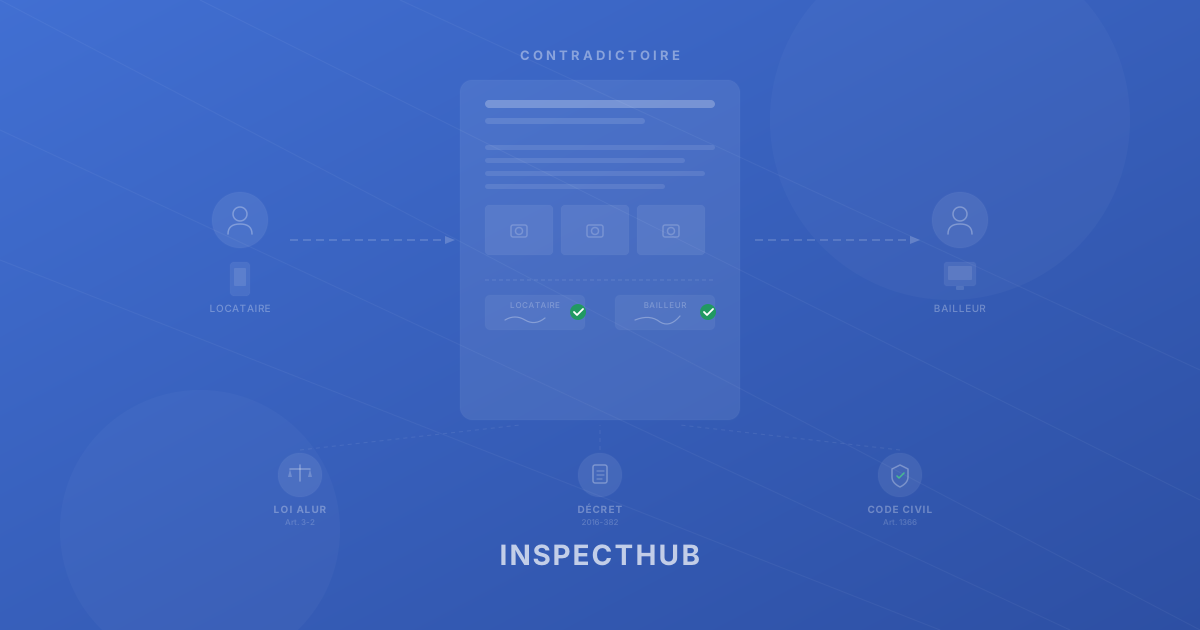
The reason comes down to one word: contradictoire. It's the central legal principle governing the état des lieux in France. If your document doesn't satisfy this requirement, its quality is irrelevant — it's legally fragile. And most landlords discover this too late, when a dispute is already underway.
Start with the law itself.
The three legal pillars of the état des lieux
French property inspection law rests on three texts. Each covers a different aspect.
1. The law of July 6, 1989, amended by loi ALUR (2014)
Article 3-2 of loi n°89-462 establishes the foundational principle: the état des lieux must be drawn up "contradictoirement et amiablement" (jointly and amicably) by both parties, or by a mandated third party. It's mandatory at both move-in and move-out, for furnished and unfurnished rentals alike.
Without a move-in inspection, the property is presumed to have been delivered in good condition. The tenant must then return it in good condition — which can work against them. Conversely, a landlord without a move-out inspection will struggle to justify deposit deductions.
2. Décret n°2016-382 of March 30, 2016
This decree specifies mandatory content and formatting. It has applied since June 1, 2016.
Required at both entry and exit:
- Type of inspection (entry or exit)
- Date
- Property location
- Names of both parties and landlord's address
- Names of any representatives, if applicable
- Individual meter readings (water, energy) where applicable
- Keys and access means inventory
- For each room: precise description of the condition of floor, wall, and ceiling coverings, equipment, and property elements
Additionally required at exit:
- Tenant's new address
- Date the entry inspection was conducted
- Changes in condition since entry
For furnished rentals:
- A detailed furniture inventory (number, type, condition of each item), annexed to the lease
Format requirement: Entry and exit documents must have a similar presentation to allow comparison. They can be a single document or two separate ones, in paper or digital form. The document may be supplemented with observations and illustrated with images.
3. Article 1366 of the Civil Code
This article establishes technological neutrality: an electronic document has the same probative force as a paper document, provided:
- The person it originates from can be duly identified
- It is created and stored under conditions that guarantee its integrity
In plain terms: a digitally signed état des lieux carries the exact same legal weight as a paper one, as long as the tool used identifies the signatories and ensures the document hasn't been tampered with.
The contradictoire principle: what the law actually says
This is the most misunderstood — and most important — point.
What "contradictoire" requires
The état des lieux must be drawn up with both parties present, or their authorized representatives holding a power of attorney. In practice, this means:
- Both parties must participate in the process
- Both parties must observe and acknowledge the property's condition
- Both parties must sign the final document
- An inspection conducted by only one party is unilateral and has no legal value
What "contradictoire" does NOT require
This is where it gets interesting:
- The law does not mandate both parties being physically present in the same room at the same time
- The law explicitly allows representation by proxy — a representative with written power of attorney can act on behalf of either party
- The law explicitly allows digital documents and electronic signatures (Article 1366 of the Civil Code + eIDAS regulation)
- Case law has validated digital états des lieux with timestamped photos and e-signatures (Paris Court of Appeal, 2022)
The key question: does asynchronous mean contradictoire?
This is the grey area that every landlord using a digital tool needs to understand.
In a traditional inspection, both parties walk through the property together. The process is inherently simultaneous. But the law doesn't say "simultaneous." It says "contradictoire" — meaning each party had the opportunity to express themselves and raise objections.
A tenant who had the opportunity to participate will find it much harder to contest the contradictoire nature of the inspection afterward. Similarly, a landlord who had access to complete documentation, could add observations, and signed the document, has participated in a contradictoire manner.
What matters legally is that each party contributed their own observations, which justifies the contradictoire nature of the document.
Why in-person inspections fail at being truly contradictoire
Here's the paradox: the in-person état des lieux is supposed to guarantee the contradictoire process. In practice, social pressure undermines it.
The politeness problem. When you're face to face with your tenant, who's going to point out every scratch, every mark on the wall? Nobody wants to create an awkward situation. Result: real issues get ignored during the inspection, then resurface weeks later as disputes.
The time problem. An in-person inspection typically lasts 15 to 20 minutes. In that window, it's physically difficult to produce a room-by-room description with detailed observations on every surface and piece of equipment, as the decree requires.
The format problem. A handwritten paper form doesn't easily accommodate timestamped photos, doesn't guarantee matching formats between entry and exit, and doesn't instantly provide copies to both parties.
In short: the in-person inspection satisfies the letter of the contradictoire requirement (both parties are present), but often fails to satisfy its spirit (producing an honest, complete, mutually acknowledged record).
What digital tools change
A digital inspection tool, designed within the legal framework, can satisfy the contradictoire requirement more reliably than paper.
Complete documentation. A guided room-by-room workflow with structured photo capture produces a more detailed inspection than any paper form. 50+ photos on average across InspectHub inspections, versus the few handwritten notes of a traditional inspection.
Genuine engagement from both parties. When tenants document without social pressure, they're more thorough. When landlords review complete documentation with photos, they have real visibility into the property's condition. Both parties engage with facts, not a fleeting impression.
Legal traceability. Timestamped photos with metadata (date, time, geolocation), electronic signatures compliant with the eIDAS regulation, and documents stored with integrity guarantees. This is exactly what Article 1366 of the Civil Code demands.
Instant copies. The decree requires each party to receive a copy at the time of signing. A digital tool does this automatically, by email, instantly.
Current limitations: let's be honest
Today, most digital tools — including InspectHub — work asynchronously: the tenant documents, then the landlord reviews and signs. It's effective, but the landlord's review step remains lightweight. A court could argue that reviewing photos after the fact isn't the same as jointly establishing an inspection.
This is where digital needs to evolve. The goal: making the landlord's engagement as substantive as the tenant's, without reverting to the in-person model that creates the problems we're trying to solve.
The direction: making the contradictoire process happen synchronously — where issues are flagged for both parties as the tenant documents, and the landlord's review becomes an active part of the inspection — without requiring physical co-presence. This isn't circumventing the law. It's taking it seriously.
Photos: not mandatory, but decisive
Photos are not required in an état des lieux. Décret 2016-382 authorizes them as illustrations, without mandating them.
But in practice, they change everything.
The Paris Court of Appeal validated deposit retention in 2022 based on a digital état des lieux with timestamped, annexed photos. Courts recognize their probative value, provided they are:
- Authentic, without retouching
- Accompanied by metadata (date, time, location)
- Integrated into the document signed by both parties
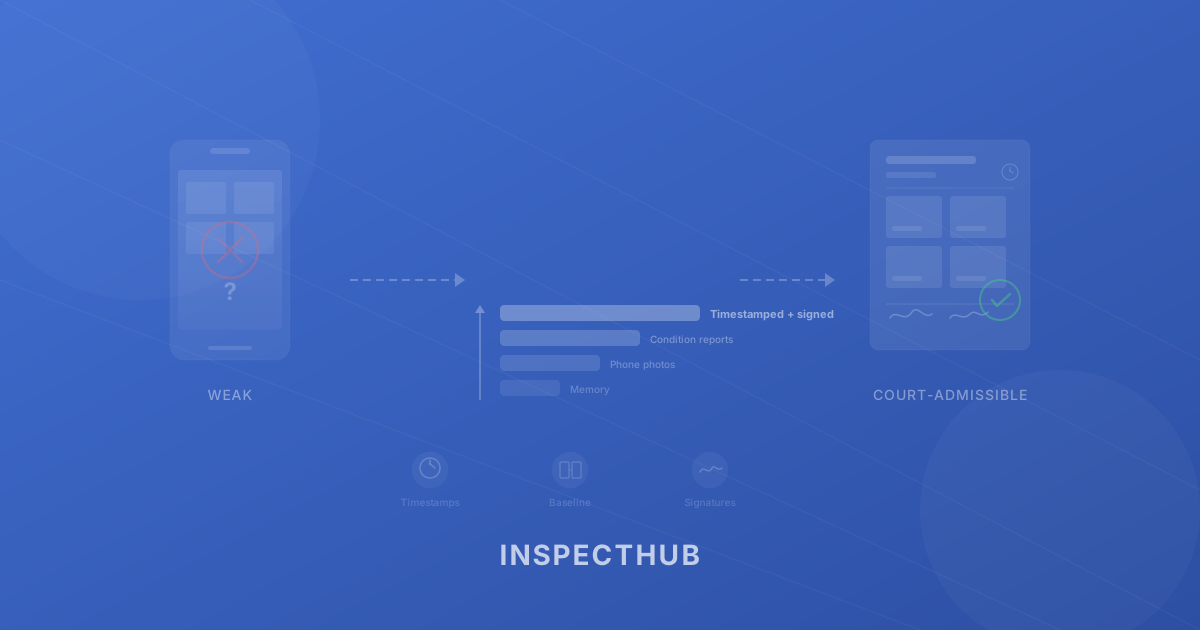
Photos without context, without timestamps, stored only on a phone, carry significantly weaker evidentiary weight. The difference isn't in taking photos — it's in how they're captured, stored, and tied to the signed document.
Vétusté: the most common trap
Vétusté (wear and tear) is defined as "deterioration resulting from time or normal use." A wooden floor wearing down after 15 years of occupancy is vétusté. A cigarette burn is damage.
The distinction is simple in theory, but it's one of the top sources of disputes in practice. And there is no official government depreciation grid.
Valid grids must come from collective rental agreements established through the National Consultation Commission (CNC). Since loi ALUR, tenants can request that a depreciation grid be annexed to the lease.
Our advice: systematically annex a depreciation grid to every lease. It's optional, but it dramatically reduces dispute risk at move-out.
The tenant's right: 10 days to amend
A detail many landlords miss: the tenant has 10 calendar days after signing to request additions to the move-in inspection.
This right covers forgotten items or hidden defects: a door that doesn't close properly, an appliance that doesn't work, a leak that only appears after a few days of use.
For heating equipment, the window extends to the first month of the heating season.
If the landlord refuses additions, the tenant can escalate to the departmental conciliation commission.
When a commissaire de justice steps in
If either party refuses to participate in an amicable état des lieux, the other can call a commissaire de justice (formerly huissier). The resulting report is binding on both parties, even if one is absent.
Key points:
- The commissaire de justice must notify parties 7 days in advance by registered letter
- Costs are split 50/50 between landlord and tenant (unless only one party initiated)
- Regulated fees depend on property size (typically €200–€300)
- The tenant cannot refuse an inspection conducted by a commissaire de justice
The 7 reasons an état des lieux gets challenged in court
Based on our analysis of case law and legal sources, here are the most common grounds:
- Not contradictoire — only one party participated, without a representative or commissaire de justice
- Vague descriptions — "good condition" without room-by-room detail doesn't hold up in court
- Vétusté/damage confusion — withholding normal wear and tear from the deposit is illegal
- Missing signatures — document not signed by both parties, or signed by an unauthorized representative
- No comparison possible — entry and exit inspections in different formats
- Timing issues — inspection not conducted on the day of key handover
- Photos without metadata — undated images not tied to the signed document
Key takeaways
- The état des lieux is governed by three texts: the 1989 law amended by ALUR, décret 2016-382, and Article 1366 of the Civil Code
- The contradictoire principle is the central requirement. It means both parties participate, observe, and sign. It does not require simultaneous physical presence.
- Digital inspection reports are fully valid under French law, provided the signatories are identified and the document's integrity is guaranteed
- Photos are not mandatory but courts give them increasing probative weight, especially when timestamped and integrated into the signed document
- Annex a depreciation grid to every lease. It's optional, but it protects you.
- Digital doesn't bypass the contradictoire requirement. Well designed, it makes the process more honest, more complete, and legally stronger than paper.

The InspectHub Team
Insights from the team building the future of property inspections.
Related Posts
Before You Hire a Property Damage Lawyer, Read This
Every property damage lawyer asks the same question first: where's your evidence? Here's what actually holds up and how to build it.
Property Inspection Apps in 2026: Why Landlords Are Going Digital
Property inspection apps grew 550% in one year. Here's what changed, the 3 types of apps available, and what to look for when choosing one.
Property Inspection Best Practices for 2026
A comprehensive guide to conducting efficient, thorough property inspections that protect both landlords and tenants.