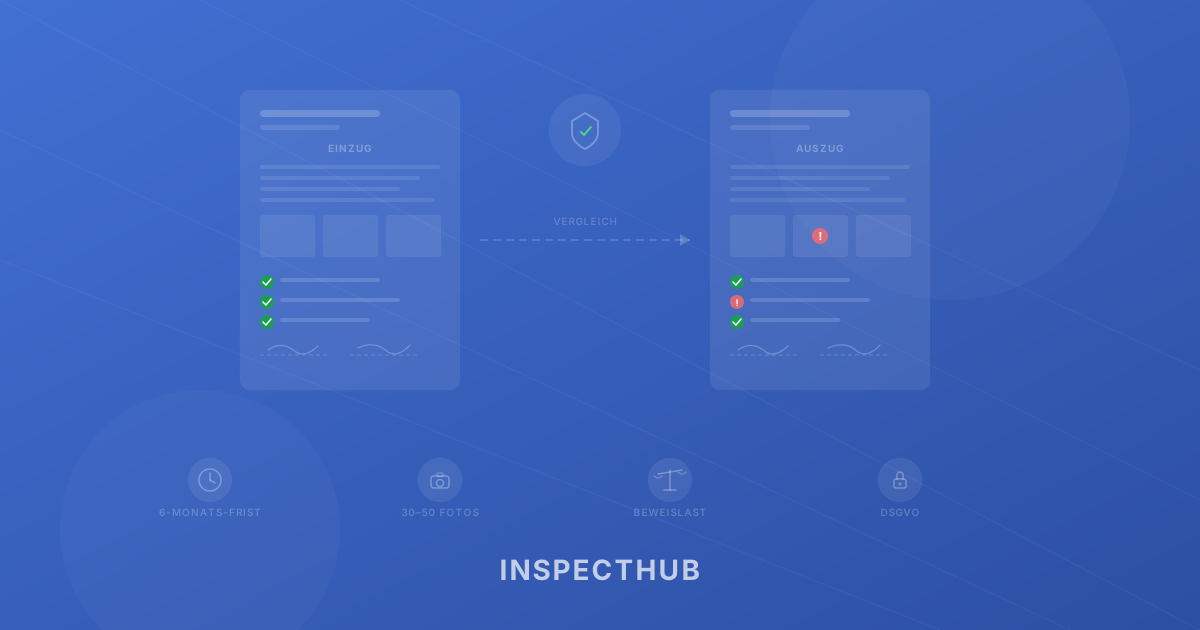
What every landlord needs to know about apartment handover in Germany
"Well, lesson learned for trusting the good in tenants." That's what a private landlord wrote in a German forum after skipping a proper handover protocol. He's not alone. German landlord forums are full of stories: smoke-damaged apartments with no documented move-in condition, tenants who simply don't show up for the handover, and damage that only becomes visible days later.
The legal situation is often clearer than most landlords think. And it can work just as well for you as against you. This article explains what legal rules apply during the Wohnungsübergabe (apartment handover), what courts look for, and how to protect yourself as a landlord.
Note: For the tenant perspective, see our separate article.
The handover protocol: not required, but your most important protection
A handover protocol (Übergabeprotokoll) is not legally required in Germany. Neither the BGB nor any other statute obliges you or your tenant to create one.
Yet in practice, the handover protocol has enormous significance. Without one, you have virtually no way to prove damage or justifiably retain part of the deposit in a dispute. An experienced landlord puts it bluntly: "I've been able to retain parts of deposits based on good protocols — and without good documentation, I couldn't retain anything."
Legally, the handover protocol is classified as a declaratory acknowledgment of debt (§397 para. 2 BGB). The Federal Court of Justice (BGH) established in a landmark ruling (VIII ZR 252/81) in 1982: The findings in a handover protocol are legally binding for both parties.
This means: What's in the protocol stands. And what's not in it, you can no longer claim.
Binding effect: what you don't document is lost
This point is frequently underestimated. Courts are clear: Defects not recorded in the protocol during the handover cannot be claimed afterward.
The Higher Regional Court of Dresden (5 U 816/22) ruled in a case where a landlord's representative signed a protocol noting "Handover broom-clean! No defects!" Two weeks later the landlord tried to claim numerous defects. The court rejected all claims. The protocol was binding.
The Regional Court of Essen (10 S 147/23) confirmed: Only defects documented in the handover protocol are binding for the tenant.
And the Local Court of Münster (4 C 720/89) ruled: A protocol with no defect entries excludes even cosmetic repair claims.
The lesson: Take the time during handover to document every defect in detail. A note like "apartment in poor condition" isn't enough. Case law demands specific descriptions, e.g., "scratch of approx. 15 cm on parquet floor in living room, right of the door." General or evaluative statements are worthless in court.
Burden of proof: as landlord, you carry the main burden
Many landlords assume the tenant must prove they didn't cause damage. That's wrong.
The burden of proof in German tenancy law follows the principle: Whoever makes a claim must prove it. If you as landlord claim damages, you must prove three things:
- The condition at move-in (move-in protocol with photos)
- The condition at move-out (move-out protocol with photos)
- That the tenant caused the damage (and it's not normal wear and tear)
The Higher Regional Court of Düsseldorf (10 U 64/02) confirmed this. Without a move-in protocol, you lack the baseline. Without a move-out protocol, you lack proof of current condition. Without both, you have virtually no chance in court.
This means: The move-in protocol is just as important as the move-out protocol. Many landlords neglect documentation at move-in because there's no conflict at that point. That's exactly what costs them at move-out.
You need both: move-in and move-out protocols. Tools like InspectHub create both systematically — room by room, with guided photo capture, automatic timestamps, and e-signatures. The baseline comparison courts demand. Free, in 15 minutes.
Hidden defects: the risk you carry
There's an important exception to the protocol's binding effect: hidden defects. Damage not visible during handover — e.g., pipe damage behind walls or severed cables in outlets — can still be claimed after the protocol is signed.
However: The Local Court of Pforzheim (WM 56, 2005) made clear that the landlord bears the risk of undiscovered damage. And the burden of proving that a defect was genuinely hidden also lies with you.
The consequence: Don't just check the obvious things during handover. Test power outlets, check drains, look under built-in furniture, open and close windows and doors. The more thorough the handover, the fewer nasty surprises afterward.
The 6-month deadline: act fast
§548 para. 1 BGB gives you a tight deadline: Claims for changes or deterioration of the property expire after 6 months. The period starts when you actually receive the apartment back, i.e., at key handover.
If you miss a defect during handover and only notice it months later, the clock is already ticking. After 6 months, your claims are time-barred — even if the damage is legitimate.
This means: Document damage immediately, get repair estimates, and set deadlines.
Photos: your strongest evidence
Photos are considered visual evidence under §286 ZPO in German civil proceedings. Many judges consider them among the strongest forms of evidence — significantly stronger than written descriptions alone.
For photos to hold up in court, they should:
- Contain recognizable date and time (metadata/timestamps)
- Clearly show the location
- Be of sufficient quality
- Include a written description (what does the image show?)
- Be available in original form (unedited)
Every photo must be assignable to a room and a specific defect. Loose smartphone photos that can't be matched weeks later are worth significantly less in court.
Important: A court (LG München I) ruled that EXIF metadata cannot constitute sole evidence due to manipulability. Combined with a signed protocol and witnesses, they significantly strengthen evidential value.
Expect at least 30 to 50 photos per apartment. 4–6 overview shots per room plus detail photos of every defect. Tools like InspectHub simplify this process significantly: the platform guides you room by room, automatically assigns each photo to the right room, adds timestamps, and stores everything in the cloud.
Digital protocols are legally valid
Since there is no statutory written form requirement (§126 BGB) for handover protocols, the principle of freedom of form applies. A digital protocol is just as valid as a paper one.
Electronic signatures are recognized in Germany under the EU Regulation No. 910/2014 (eIDAS). A simple electronic signature suffices for a handover protocol.
Digital protocols even have advantages over paper:
- Tamper-evidence: Subsequent changes are detectable
- Instant copies for both parties: No "I never received a copy"
- Photos embedded directly: No loose image files that get lost
- Cloud archiving: No protocol that disappears in a drawer
With InspectHub you can create such a protocol for free in about 15 minutes — complete with guided photo capture, legally valid templates, e-signatures, and cloud storage. No app download, directly in the browser.
Cosmetic repairs: know your clauses
The BGH has declared numerous cosmetic repair clauses (Schönheitsreparaturklauseln) in lease agreements invalid in recent years. Fixed schedules, color requirements, and end-of-lease renovation clauses fail to hold up in court in most cases.
Before demanding cosmetic repairs at handover, check whether the relevant clause in your lease is even valid. An invalid clause cannot be enforced — even if the apartment objectively needs renovation.
GDPR: what to watch for with photo documentation
Apartment photos can contain personal data if personal belongings are visible or people are recognizable. While a landlord's legitimate interest (Art. 6(1)(f) GDPR) is generally assumed for defect documentation, you should:
- Note consent for photo documentation in the protocol
- Avoid photographing the tenant's personal belongings where possible
- Use photos only for documentation (not for listings or other purposes)
- Delete photos when no longer needed (e.g., after deposit settlement is complete)
A violation can trigger a damages claim under Art. 82(1) GDPR (minimum €100 per tenant).
Key takeaways
- The handover protocol is binding for both sides — what's not documented can no longer be claimed
- You must prove the damage, not the tenant — the move-in protocol is just as important as the move-out protocol
- You have only 6 months for claims after key handover
- Photos are your strongest evidence — expect 30–50 shots per apartment, assigned to each room
- Digital protocols are legally valid and often more evidence-secure than paper
- Check your cosmetic repair clauses before making demands — most are invalid
- Mind the GDPR when taking photos — note consent, avoid personal items, delete when done
The biggest mistake isn't a bad tenant. It's skipping proper documentation out of convenience.
Because "paying tuition" isn't a business model.
Next handover coming up? InspectHub guides you room by room through documentation. Guided photo capture, automatic timestamps, legally valid templates, e-signatures, and cloud archiving. In 15 minutes you have a protocol that holds up in court. Free, unlimited inspections. Get started free →

The InspectHub Team
Insights from the team building the future of property inspections.
Related Posts
Your rights as a tenant during apartment handover in Germany
Handover protocol, burden of proof, deposit protection: what German law actually says about Wohnungsübergabe — with court rulings and a practical checklist.
État des Lieux in France: what the law actually requires
Loi ALUR, décret 2016-382, and the contradictoire principle — what French law actually requires for property inspections, and how digital tools satisfy it.
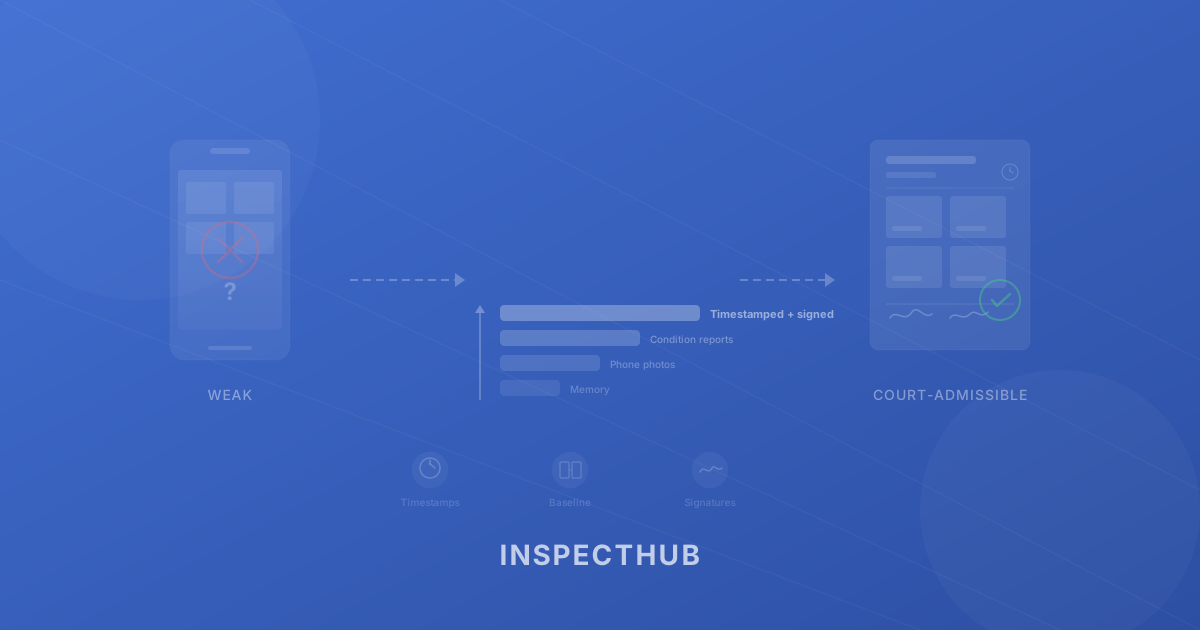
Before You Hire a Property Damage Lawyer, Read This
Every property damage lawyer asks the same question first: where's your evidence? Here's what actually holds up and how to build it.