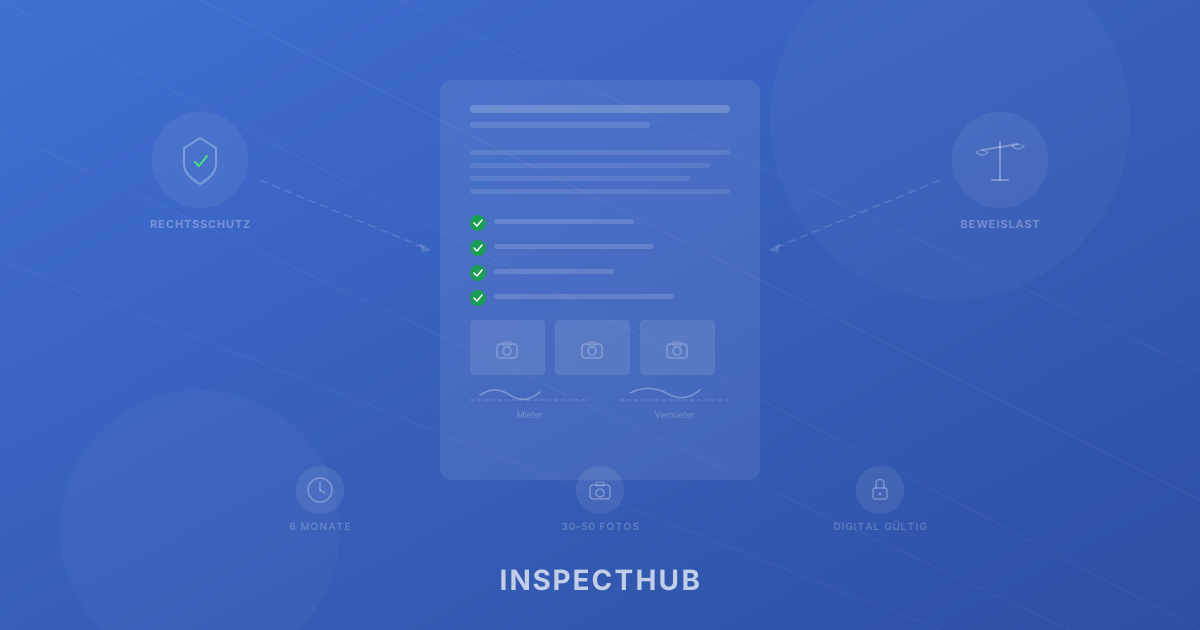
Your rights as a tenant during apartment handover in Germany
Moving out of a German apartment and worried about losing your deposit? You're not alone. In German tenant forums, one renter wrote: "I was on the verge of a breakdown." Another: "We're now worried that pre-existing defects will be blamed on us and we'll have to pay." And one thread on urbia.de is simply titled: "Fear of apartment handover."
The good news: German tenancy law is on your side in more ways than you might think. You just need to know how. This article explains your rights during the Wohnungsübergabe (apartment handover), how to protect your deposit, and what courts have ruled in tenants' favor in recent years.
The handover protocol: not required, but your strongest weapon
Let's start with the most important thing: a handover protocol (Übergabeprotokoll) is not legally required in Germany. No provision in the German Civil Code (BGB) obliges you or your landlord to create one.
Yet in practice, the handover protocol has enormous significance. Why? Because it creates a legally binding record of your apartment's condition at move-in and move-out. And that's exactly what every deposit dispute comes down to.
Legally, the handover protocol is classified as a so-called declaratory acknowledgment of debt (§397 para. 2 BGB). In plain English: What's in the protocol is binding. For both sides.
The Federal Court of Justice (BGH) established this in a landmark ruling (VIII ZR 252/81) back in 1982: The findings recorded in a handover protocol are legally binding for both tenant and landlord.
The most important rule: what's not in the protocol can't be claimed later
This is where it gets really interesting for you as a tenant. Courts have repeatedly ruled: Defects not documented during the handover cannot be charged to you after the fact.
A striking example: A landlord's representative signed a protocol noting "Handover broom-clean! No defects!" Two weeks later, they claimed numerous defects. The Higher Regional Court of Dresden (5 U 816/22) rejected all claims. The protocol was binding.
The Regional Court of Essen (10 S 147/23) recently confirmed: Only defects and obligations listed in the handover protocol are binding for the tenant. Subsequent claims? Excluded.
And the Local Court of Münster (4 C 720/89) went even further: A protocol with no defects recorded excludes even the landlord's cosmetic repair claims.
What this means for you: If you have a clean handover protocol with no defects, signed by both parties, your landlord has no leg to stand on if they suddenly "discover damage" afterward.
Burden of proof: your landlord must prove it, not you
Many tenants believe they must prove they didn't cause damage. That's wrong.
The burden of proof in German tenancy law follows a clear principle: Whoever makes a claim must prove it. Specifically:
- Does your landlord want money for damages? They must prove three things: the condition at move-in, the condition at move-out, and that you caused the damage.
- Does a protocol exist where the defect isn't mentioned? Then there's a factual presumption that the defect didn't exist. Your landlord must prove otherwise.
The Higher Regional Court of Düsseldorf (10 U 64/02) made it clear: The tenant does not need to prove defects not listed in the protocol. And the Higher Regional Court of Celle confirmed: The tenant is only responsible for defects noted in the protocol.
The landlord remains responsible for proving their claims, with or without a protocol. But without one, it gets harder for both sides.
Your protocol decides your deposit. When your landlord has to prove damages and you have a clean, signed protocol with photos, your position is strong. Tools like InspectHub create exactly that protocol — room by room, with guided photo capture, automatic timestamps, and e-signatures. Free, in 15 minutes, directly in your browser.
The 6-month deadline: your landlord doesn't have forever
Even if your landlord has legitimate claims, they must act quickly. §548 para. 1 BGB sets a special limitation period of just 6 months for landlord claims related to changes or deterioration of the property.
Important: The clock starts not when the lease ends, but when the landlord actually receives the apartment back — i.e., at key handover.
After 6 months, the claims are time-barred. A landlord who contacts you a year after move-out has virtually no legal recourse.
What to do if no protocol was created at move-in
This is unfortunately the norm. In forums it's the most common scenario: "The key handover was scheduled. The landlord forgot the appointment, showed up an hour late, just handed us a key and drove off. There was no handover protocol either."
No protocol at move-in does not mean you're lost. But it does make the evidence situation harder at move-out. Here's what you can do:
- Create your own protocol retroactively. Document the apartment's condition as quickly as possible with photos and written descriptions. Have a witness sign it.
- Photograph everything. Photos are considered visual evidence under §286 ZPO in German civil proceedings and are often stronger than written statements.
- Send the documentation by email to your landlord. This gives you a timestamp and proves you communicated the move-in condition.
Expect 4–6 overview shots per room plus detail photos of existing defects. For an average apartment, that quickly adds up to 30 to 50 photos. Better to overdo it than to underdo it.
Note on EXIF data: A court (LG München I) has ruled that EXIF metadata in photos cannot constitute sole evidence due to their susceptibility to manipulation. Combined with other evidence (witnesses, protocol, email records), they significantly strengthen the case.
The practical problem: Taking 50 photos, assigning each to the right room, compiling everything into a protocol, getting signatures, archiving it all tamper-proof — that's barely realistic on moving day, between boxes and time pressure. Tools like InspectHub guide you step by step through the documentation: room-by-room photo capture, automatic timestamps, e-signatures, and cloud storage. All in the browser, free, no app download. In 15 minutes you have a legally valid protocol with all photos, instantly available to both parties.
Cosmetic repairs: most contract clauses are invalid
"Can I paint my apartment myself even though the landlord wants a professional job?" This question comes up constantly in forums. The answer in most cases: Yes.
The BGH has ruled in multiple decisions that most cosmetic repair clauses (Schönheitsreparaturklauseln) in lease agreements are invalid. Fixed schedules ("repaint kitchen and bathroom every 3 years"), color requirements at move-in ("white only"), and end-of-lease renovation clauses have been struck down almost across the board.
The Local Court of Münster (4 C 720/89) confirmed: If the handover protocol contains no defects, the landlord cannot demand cosmetic repairs afterward.
Practical tip: Before spending days painting before move-out, check whether the clause in your lease is actually valid. A quick consultation with a tenant association (Mieterverein) can save you a lot of unnecessary work.
Digital protocols and photos are legally valid
If your landlord claims a digital handover protocol is "not valid" — that's incorrect. Since there is no statutory written form requirement (§126 BGB) for handover protocols, the principle of freedom of form applies. A digital protocol — whether as a PDF, in an app, or via email — is just as valid as a paper one.
Electronic signatures are also recognized in Germany under the EU Regulation No. 910/2014 (eIDAS). Even a simple electronic signature (e.g., signing on a tablet) is sufficient.
A digital handover protocol with electronic signatures, like the one you can create for free with InspectHub, has the same legal validity as a handwritten paper document. With the added benefit that it can't be lost, can't be altered after the fact, and both parties receive a copy instantly.
Your checklist for the next apartment handover
Here are the concrete steps you should follow at every handover — whether moving in or out:
Before the handover:
- Join a tenant association (ideally before a problem arises, not after)
- Have the cosmetic repair clause in your lease reviewed
- Prepare your own handover protocol (free templates available from the German Tenants' Association or digitally with guided photo capture and e-signatures via InspectHub)
- Arrange a witness (adult, uninvolved)
During the handover:
- Go through each room individually and document the condition
- Take 30–50 photos (overview shots + details of defects)
- Read meter levels (electricity, gas, water)
- Record the number and type of all keys
- Check power outlets, drains, and hidden areas
- Have the protocol signed by both parties
- Don't sign anything under pressure. You are never obligated to sign an inaccurate protocol
After the handover:
- Secure a copy of the protocol (photo, scan, email to yourself)
- Back up photos and don't delete them from your phone
- For deposit recovery: request in writing via registered mail with a deadline (14 days)
A note for expats
International tenants in Germany are particularly vulnerable. In an English-language forum, someone wrote: "It's common in Germany for landlords to take advantage of expats and not return the security deposit. Often, expats don't hire a lawyer because they lack legal insurance."
If you don't speak the language fluently or don't know the system: The same rights apply to you. A handover protocol doesn't need to be in German to be valid — but it helps. Bring a German-speaking friend as a witness and document everything with photos. InspectHub offers legally compliant templates in German, English, and French. You can go through the process in a language you understand and still get a protocol that holds up in German courts.
Key takeaways
- The handover protocol is binding for both sides — subsequent claims are excluded if the protocol is clean
- The burden of proof lies with the landlord, not with you
- Your landlord has only 6 months after key handover for damage claims
- Photos are among the strongest evidence in court — expect 30–50 shots per apartment
- Digital protocols and signatures are legally valid under eIDAS and German law
- Most cosmetic repair clauses are invalid — have your lease reviewed before you renovate
You don't need to be a lawyer to know your rights. But you need to know them to use them. With an average deposit of €1,500 to €4,500, the apartment handover is not something to take lightly.
Your deposit is worth it.
Handover coming up? InspectHub takes the stress out of documentation. Guided room-by-room photo capture, automatic timestamps, legally valid templates, e-signatures, and cloud storage. In 15 minutes you have a protocol that holds up in court. Free, no app download. Get started free →

The InspectHub Team
Insights from the team building the future of property inspections.
Related Posts
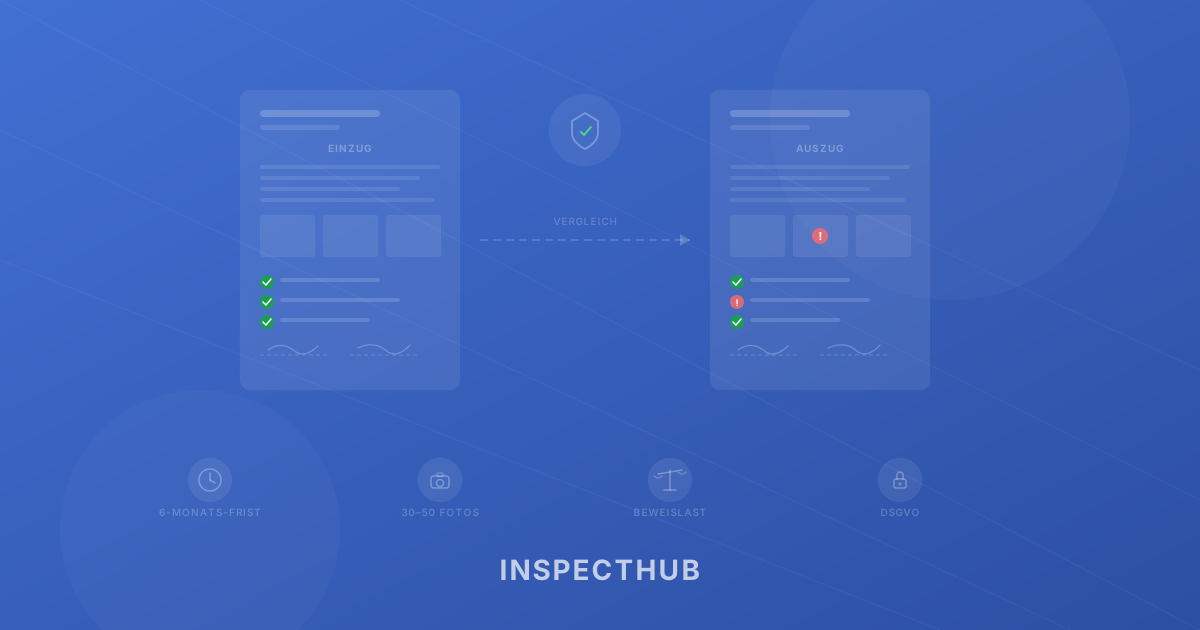
What every landlord needs to know about apartment handover in Germany
Handover protocol, burden of proof, 6-month deadline: German law on Wohnungsübergabe for landlords — with court rulings, GDPR notes, and a practical checklist.
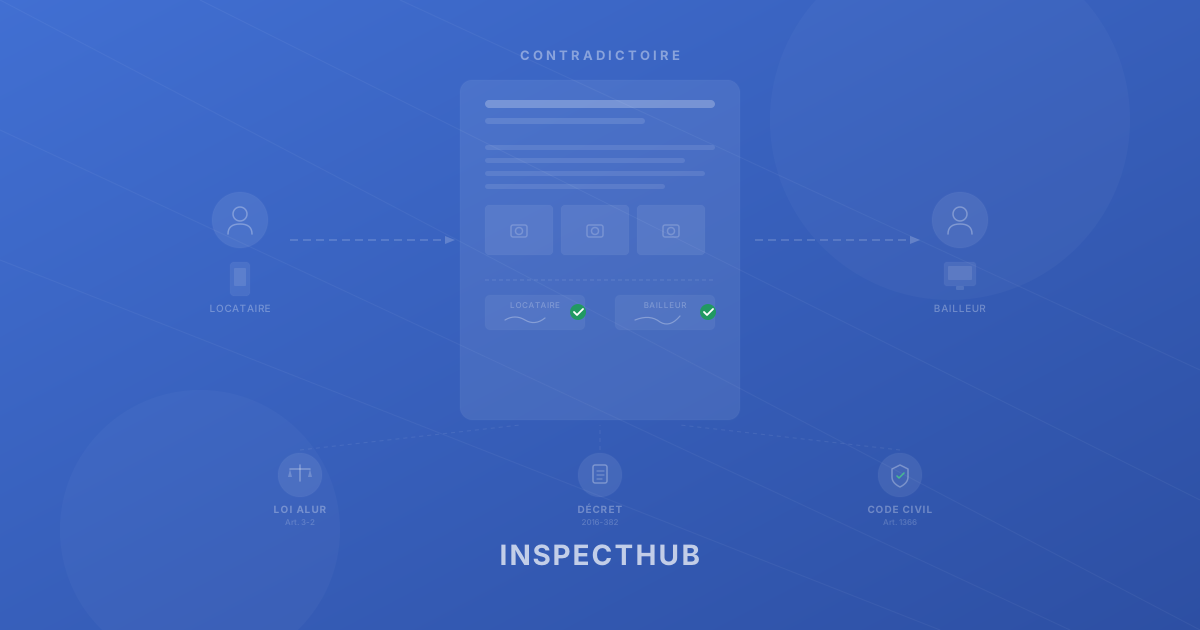
État des Lieux in France: what the law actually requires
Loi ALUR, décret 2016-382, and the contradictoire principle — what French law actually requires for property inspections, and how digital tools satisfy it.
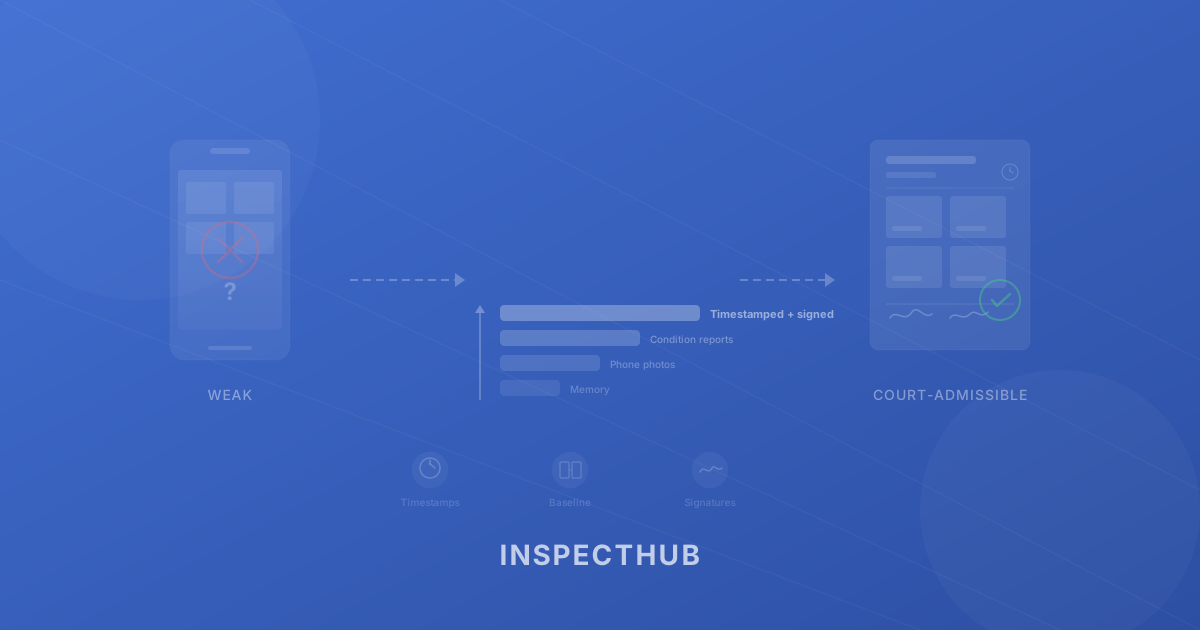
Before You Hire a Property Damage Lawyer, Read This
Every property damage lawyer asks the same question first: where's your evidence? Here's what actually holds up and how to build it.